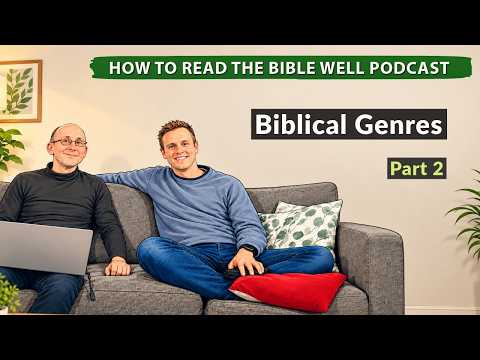
How To Read The Bible Well · 24 September 2026
How can we interpret the Bible well?
2. The Bible And Interpretation Part 2 - How To Read The Bible Well Podcast - Episode 2
Watch on YouTubeSummary
The speaker explains that interpretation is part of all communication, so the question is not whether we interpret the Bible, but whether we do it well. Our aim is to recognise the author’s intended meaning rather than invent our own. The Bible is understandable, although some passages are difficult. We can have confidence in central truths while admitting when we do not know what a passage means.
The speaker identifies two barriers: distance from the biblical world and the biases we bring. Differences in time, culture, geography and language can make familiar ideas for the original readers unfamiliar to us. Research can help close those gaps. Our beliefs and experiences also shape how we read. A willingness to listen, learn and obey is helpful, but we must allow the Bible to challenge and change our assumptions.
The speaker encourages readers to weigh the available evidence and consider which meanings are defensible. Common mistakes include going beyond what is written, treating figurative language literally, missing cultural meaning and resisting a challenging message. We should avoid both arrogant certainty and an unwillingness to stand for truth. When Christians disagree, the response should be patient instruction, love and respect—not quickly labelling or giving up on one another. Continued conversation may also reveal that we were wrong. Becoming a better reader is a process of growth, supported by humility and a willingness to keep learning.
Summary drafted from the talk; reviewed by the church team.
Questions this talk explores
- Why is interpretation necessary when we read the Bible?
- How can we recognise the author’s intended meaning?
- How do cultural distance and personal biases affect our reading?
- How can we hold convictions while remaining open to correction?
- How should Christians treat one another when they disagree?
Read the talk
Transcript from the recording’s captions. Automatic captions may contain errors.
Welcome back to part two of lesson one. In part one we looked at the Bible itself really understand how it came to be, understanding some of the different kind of genres and and structure as well as the timeline and everything else. And in part two we're looking at interpretation. So Simon, take us away. >> Okay. Well, you know, sometimes people say, "Why don't you just do what the Bible says? Why do you need to interpret it?" >> Yeah. >> And the truth is everything we say is interpreted. So we have a little bit of, you know, humor there. Um, you know, that people can very easily uh misinterpret something we say. So we we say something and somebody takes it a different way than than we intended. Um, and you know, what we
realize with an example like this is that, yes, people are interpreting what we say all the time. Everything we say gets interpreted. What I'm saying now, you are interpreting that. Um, and so we can't avoid that. And so the question is not kind of, you know, how do I avoid >> >> uh you know, to interpretation and just do the plain kind of >> Yeah. >> the Bible says. It's no, how do we interpret well? >> Yeah. >> That's the what's important. >> And and I guess just as a quick comment on that is and what what I guess what I mean I hope for and excited for is that there is a wisdom and an understanding. There are certain things where there's quite a clear interpretation or there are things that where you can interpret quite clearly correctly or incorrectly. And I guess there are other times where maybe there's more nuance. So we always need
to we can have a degree of clarity but continue to be humble at the same time that maybe we can continue to learn and grow and adapt. So what what I'm looking forward to and excited about is really just you to give us more and more of those tools to help us to interpret well and to have real good clarity on the things that we can. >> Mhm. >> Yeah. >> Yeah, so what we're trying to do when we interpret the Bible is to to recognize the intended meaning. So we assume that the author who wrote the text intended something when they wrote it. And we want to work out we're not making up a meaning for ourselves. It's not us inventing something. Um >> Me putting my own meaning on the scripture and using it for another motive. >> >> No, I mean some people will claim that today and that's the you know, I
disagree with that. I think you know, what we're doing when we interpret the Bible what we should be doing at least is recognizing the author's intended meaning. Um and we assume >> Just to go back what you just said that you some people claim that and you just said what some people claim what sorry? >> Some people claim that that um that when we that since well, basically, I can't know what you intend. Yeah. And I certainly can't know I mean I could ask you, yeah, but I can't know what somebody wrote something 2,000 years ago intended cuz they're dead. >> Ah, okay. Yeah. >> And so, you know, there's this argument that well, you since you can't know what somebody intends, it's a waste of time to even try. >> Okay. Okay. Okay. >> But that's ridiculous because actually when we in when we communicate, we're always inferring what people intend.
Um and you know, and so that's just part of the the the communication process. >> And sorry if I'm taking you off track here or you're probably going to come to some of this. But I think that's a really interesting there's a tension there even I think for us today where maybe in our our particular fellowship but I know in different churches where if there's an overly rigid interpretation or if it's a sense of a certainty that you can only look at it this way and unless you agree with me, you're wrong kind of an approach. But then on the other over swing, it can be what you've just expressed where well, we can't really ever know or maybe we're not sure and there's just constant uncertainty when everyone's just fuzzy all the time. And and it seems to me neither of those are good. When it we've got total fuzziness and we can never really know
what the intentional meaning was, well, we're missing out on so much. but then if we're overly rigid, I think of the Pharisees in the Bible and other examples where we can get stuck and we actually sometimes completely miss the point because we think we've got it all figured out and God's trying to get something new across to us. >> Yeah, often people are being rigid about the wrong things. >> Yeah. >> So, I think there's things we can be sure of like the existence of God. >> Yeah. >> Or the that you know the that Jesus is the the way to to salvation. So, I think those those types of um uh facts I think are the basis of Christianity and and can be certain of them. But yes, of course there are other things which um you know, which are much harder to know and there are passages where I would just say I don't know what the
author intended at this point. >> Yeah. >> But you know, we in general, you know, the the Bible is understandable and um and what we're trying to do, you know, when we're saying talking about the author's intention is we're we're thinking about you know, what could they have meant? >> Yeah. >> And what couldn't they have meant? >> Yeah. >> Uh we can cuz you can rule out a lot of meanings like it you know, reading a 20th century or 21st century meaning into a an ancient text is you know, it's something they couldn't possibly have meant themselves. >> Yeah, yeah. >> Now, of course it is possible for prophecy that that God kind of inspires something that the author doesn't understand, but that's actually the exception in the Bible even in the Bible.
>> Yeah. >> Right? Nearly always it's it's the author's intention is the same as as God's intention. >> And and it kind of goes back to what you said in part one where the scripture is authoritative, but they're also sufficient where even on areas where there might be nuance or maybe we're not entirely certain, it's it's often not a real core issue. Whereas for all the things that matter most, we we can be really clear. >> Yeah. >> the scripture is sufficient to guide us towards >> Yeah, I think the understanding we need. >> Yeah, and I think it's also an indicator of what's >> >> essential. >> Yeah. >> Right? That if it's not clear, it's probably not essential because God is capable of communicating clearly. >> Yeah, exactly. If he left it open to interpretation, there's probably a good reason for that. >> Yeah. >> Sounds good. Okay, yeah. >> Okay. So, the goal at the end is is to
be a good reader, right? To avoid mistakes, to be able to um to read and understand the Bible as it's intended. >> Yeah. >> Um and and that will involve some work. Um we'll talk about this in the next lesson on kind of the different uh methods that are involved. So, historical, grammatical, literary, cultural, there's different factors that go into to understanding the Bible. >> Um and it's a you know uh uh very open area that you can always learn more. >> Yeah. >> That you'll never get to a point where you know everything there is to know about the history or the culture of of biblical times or >> you know, that there are you know, libraries of books written about it and um you know, it's not necessary to know everything, but but some knowledge
can be useful and and there are some things where where it does help to to to do a bit of research and just to understand the um where people are coming from. >> Yeah. >> Okay. So, I want to talk about two things that that um kind of can stop us from interpreting something correctly. >> Okay. >> And one of them is distance. Right? And I mean, this doesn't happen in you know, conversation between me and you because you know, we come from relatively similar cultural backgrounds even though I come from the other side of the world to you. >> Yeah, sure. Yeah. >> But, you know, if we're >> We're living in the same time and period. >> We are living in the same century. We're we've we've made it to the same millennium. >> Yeah. >> And um and so
when we're reading the Bible, you know, there's a a lot of different um a lot of distances between us and >> Yeah. and the biblical writers and readers those who received the original text. One is time of course that just a long time ago and so some stuff is just lost in time. You know, so I'm just giving some examples here that you know the people who live in Samaria fear for the calf idol of Beth Aven. >> What is the calf idol of Beth Aven? >> Precisely. >> We don't know. >> Well, I mean actually we may well know but but that's not the point. The point The point is most of us are unaware of the calf idol that was in Samaria and you know, we have to do a bit of historical >> read that and be like oh yeah the calf
idol of Beth Aven. I would have to go and research and be like what does that mean? What are they talking about? Why did they fear it? Like it would >> Where was Samaria? Where were the people and all of that? >> Okay. >> You know, cultural differences. So this classic verse you know, it's like precious oil poured on the head running down on the beard. >> >> So is that something good? >> Yeah. >> Is that something bad? >> Yeah. Yeah. >> You know, to the >> I don't understand what that meant to them. >> Yeah. Cuz to us oil on my head running down onto my my absent beard. I don't If I had a beard and oil was running down not a great thing to me but to them it >> It was obviously it was. Yeah, exactly. So so that was >> There's a richness to something like that that doesn't doesn't translate to us. >> So the positive connotation is lost cuz we got a very different culture and we
just don't have this understanding that that the original readers had of that. >> Yeah. >> There's also geographical references. Cedar of Lebanon I mean >> Oh yeah. Yeah. Yeah. >> You ever been to Lebanon? >> I have not. No. >> Have you seen the cedars that grow there? >> I've not seen the cedars. I know some great people from Lebanon but I've never actually visited. Yeah. >> So >> What would they actually look like? >> What would the splendor be like? >> >> Who knows? And of course language is another one. >> yeah, the um >> So there's some some hieroglyphics there. >> but yeah. >> >> Um, but that's a new commandment I give to you. Um >> Okay, cool. >> So there's a barrier of language, right? Like it was written in ancient language that most of us don't speak. Some of us have learned it. Uh, of course, you know, we have
translations of the Bible into most modern languages, but um, you know, things can get lost in translation or they can become ambiguous. I think that sometimes something that had two meanings in English only has one meaning in the original text. And if you can look back at that and understand, oh, it can't have this other meaning in English. >> Yeah. >> And that clarifies it. And so sometimes that's, you know, the a necessary step. But all of those things can create a barrier to us from understanding. The other thing is the barrier that's within us, right? The the biases that we have. That when we approach any text >> Yeah. >> we have a lifetime of of >> Yeah. >> you know, learning and beliefs and thoughts. Um, and of course when you read the Bible, we have a view of God. >> Yeah.
>> a view of what the Bible is. We have a view of inspiration. And if you don't believe in God, you're going to look at the Bible differently than somebody who does. >> Yeah. >> And and so on. If you believe the Bible's inspired by God, you read it differently than if you say it's just a, you know, a nice book. >> Yeah, we I guess even this is really helpful cuz I even think of what I would call word baggage. Like sometimes there are certain words that just immediately my mind jumps to certain places. And then whether that's good or bad. And so it's being aware that I I bring a lot of that to my reading of the Bible, to my interpretation. Now I've got to understand is my baggage like the right kind of baggage, I suppose. Or is my mind filled with the right things when I'm reading certain words in the scriptures? >> Yeah.
>> Yeah. Or just could they have a different meaning is Yeah, you know, the questions we have to ask. And so, you know, I make the claim and I think it's uh, you know plainly true that that that we are all biased in in one way or another and I that's not a bad thing, right? That we can have good biases. So you know as I I list here a number of different things that willingness to listen, to learn, to accept, to obey the Bible is is they're good biases. If you come to the Bible with that willingness um you will get a lot more out of it uh than if you don't. >> Yeah. >> And so you know that type of bias is important. In the Bible itself it says without faith it's impossible to please God. So faith is a bias that we have, right?
>> Yeah, yeah. Which is a good bias as a person of faith, yeah. >> Absolutely, but you know we have to just recognize that you know that we have these biases and you know as much as our biases influence um the way we interpret the Bible um the Bible should also influence our >> Mhm. >> biases, all right? And so it's so it goes around in this circle, but it's not it shouldn't be a circle where it's just kind of you know um going kind of >> round and round and round >> round and round and nothing changing. But as we read the Bible, you know, with our biases, I mean if we acknowledge our biases then that helps us to address them, but also the Bible will point out some biases. >> Yeah.
>> Right? And and that helps us then >> can keep improving and growing and I guess becoming more and more in line with God's original intention. >> Yeah, so so the the the picture we give is is this spiral that rather than going around in circles, but as we go around in circles we actually get a bit closer to the the truth or the intended truth or to to to what God wanted us to understand. Um and and so you know we're but that's only if we allow the Bible to to speak to us and to you know to to change our preconceptions and and and biases that we have. >> Which I and I love that idea cuz even even when I talked about before that that tension I've seen on both ends of the spectrum. Another way of thinking about this is a pendulum. And we and we may end up drifting to one side more
than the other at times. But but getting stuck in an in an over rigid certainty where we're almost not allowing God and and our reading of scripture to kind of to soften us or teach us or adjust our biases. And if we approach with a like a cynicism or just constant skepticism or a constant uncertainty, not thinking we can ever know, then we don't kind of progress in any way. So >> Yeah. >> And it but it's also nice that you don't have to have all the answers all the time and complete perfect knowledge and certainty that well, I can keep growing in this and develop this over time. And and actually in a one way have a faith and a trust that God will keep guiding me to greater truth over time. >> Yeah. It's encouraging. >> And that brings us to the the the final topic of this this lesson which is the
our posture. >> Yeah. >> So so can we be certain? Well, >> >> I think there are some things we can be certain of and other things we can't. Um what we should do is, you know, what many professionals call due diligence. >> Yeah. Yeah. >> Right? Is that we use the evidence that that's available to to inform our interpretation of the Bible. And we determine what is most the most likely meaning, but also that we're open to seeing that there is a range of other alternative interpretations which might be defensible. But that doesn't mean that every interpretation is defensible. Many will not be. >> Yeah. >> But you kind of realize, okay, I think it means this, but it could also mean this or this, but it certainly can't
mean this or that. And that's kind of what we should be able to to get to. >> Um yeah. >> And we can make mistakes in many different ways, right? One is is going beyond >> Yeah. >> what's written. So taking you know, verse which says one thing and thinking it says a lot more than it says. Um sometimes people take something that's figurative language and they just think of it as as uh being literal and that can be a um lead to all types of misinterpretations. Um missing the cultural nuances and you know, that's also a a big thing that can uh lead us astray and of course unfortunately the you know, refusal to accept what's said. Um sometimes people just don't want to hear what the Bible says because it it you know, challenges
them and and is asking for a change. Um and so that um you know, will lead people to to misinterpret the Bible because they just refuse to accept it and then they then will come up with all types of excuses and reasons why it doesn't mean what it >> Yeah. >> what it does. >> the fundamental posture of my heart genuine truth seeking? Am I really trying to find God and find the answers or am I trying to as Timothy would talk about scratching your itching ears or as Paul would talk about in Timothy. Um I really want I really don't want to change or believe something or adjust, so I'm kind of you know, having all kind of clever workarounds to make certain things say what I wanted to say or not, yeah. >> Yeah. Yeah, and um
so we have to be uh you know, careful of those errors. I think there's two dangers that we have in in you know, in in terms of posture that we can be arrogant and the Bible speaks very much against arrogance and pride. Right? If we think we know everything, we think we understand everything, we think we're right and everyone else is wrong. That's not a good posture to have. Um but the opposite where we think we know nothing and and you know, we don't stand up for the the truth that we can see in the Bible is also a a danger and so we want to avoid both of those. >> Yeah. >> Um but whatever we do, we need to treat each other with love and understanding, even if we disagree. So, I'm sure there'll be things that we disagree on as we talk more about the Bible.
But, that's fine. Right? If we if we have that posture of uh you know, loving each other and and treating each other with respect, um that even when we disagree on things, it it's not, you know, a deal breaker in terms of a relationship. And so, I think that's something which, particularly with people who have a very strict view of the Bible, um often end up arguing and disagreeing and and kind of um dividing. Churches divide and, you know, they split up because people disagree and they just argue. Um And they're not treating each other as as Christian brothers anymore. And I mean, often they say that, "Well, they're not a Christian brother cuz they don't follow this thing in the Bible." >> Well, exactly.
>> So, that's like just that arrogant posture, right? Of I'm right and you're wrong. Um >> And so, how do you I guess this is a really interesting I like what you said there, a Christian attitude to people who disagree, uh which is really helpful. And and I guess how do you um the in the Bible talks elsewhere, another language for this is disputable matters. And so, um and so, so Paul mentions that and there are there are several ideas like that in scripture, but I guess what's really difficult is if I believe something is a clear, absolute biblical truth, and you believe something is a disputable matter, my intention my my inclination might be to I like you said, "Well, you're not serious." Or you kind of end up wanting to cut ties and um how would you guide us even through making sure we don't fall into either of
those traps? What What would help us have the a good posture? >> I I think I mean, for those of us who are parents, you think about raising children, >> >> right? Is that it's a it's a long-term process. It's not something that happens in a day. Um and so, you know, the Bible often talks about patient instruction. And so, >> Yeah. >> you know, the temptation is that somebody disagrees or somebody doesn't listen to you the first time you discuss something with them, that you get impatient and you give up on them and say, "They're not interested. They're not open. They're not Whatever." Um but, >> Or or I say, "Oh, they're too arrogant or stubborn to understand." Or you you kind of label and >> Yeah, but a Christian attitude continues to love, right? And and doesn't give up on people and doesn't,
you know, so, you know, if I think something's important and I think somebody's wrong and and they they they, you know, I should continue to to you know, try to communicate with them and try to to show them in in in different ways, try to help them >> gently, lovingly, patiently. >> Um it's it's perseverance and patience and um you know, uh And we might find out that we're wrong. We might, through that process of engaging, engaging, engaging, um realize after a while, "Oh, actually, yeah, I was wrong." >> Yeah. I I I love that approach as well cuz there's a Yeah, I I and I think we've me individually, I think versus a community we have easily swung to these extremes at times. And I and I'm sure if we pause and think for long enough, we
could find ourselves on either of those extremes in different moments where we were probably too certain and too harsh or imposing with someone where we maybe later realized Oh, wow, I have a different view now. Or at times maybe we found ourselves lacking a confidence and the courage to be clear and firm and speak the truth on things that probably were clear and we were too vague in a way that wasn't helpful. >> Yeah. >> Um but what I love about the approach even in you speaking it, actually, it requires so much more just actual trust and faith to be to have a good degree of confidence in with this is what I believe and to keep persevering and loving it in relationships or in sharing that, but do so also with a gentleness and a humility
that allows me to be changed or corrected over time. And by God, by by others as well. So, which is where again the the way we use the word together in a community and our relationships helps it kind of keep coming alive as well. >> Mhm. So. >> That's just a I find that helpful as well. >> Realize that we're all on the same journey, right? That that we're we're trying to walk with God uh through our lives and and you know, we're all growing, we're all learning. Um then that helps us to be patient with others and to realize that you know, they're on their their journey too and and you know, we we do our best to uh to support each other in in that journey and to you know, speak the truth in love as the Bible says. Uh
and that's uh I guess the the posture that that God calls us to. >> Sounds good. Well, fantastic. >> Okay, so in summary um God speaks through the Bible. >> Yeah. >> So, we should pay attention. I think that's a you know, the our starting point. That's why we're doing this. >> That's a good basis. Yeah, that's it. >> We take him seriously in his words and his life. >> Yeah, that's right. And that's why this is important because it's if it's really a message from God, then we ought to try to understand it correctly. >> Yeah. >> And and I think we can learn to become better readers. Um we can overcome biases and cultural distance uh by learning a bit about you know, what our biases are and what the >> Yeah, I like what you said there. Those are those can be barriers, but they're not insurmountable. They're barriers
that actually we can get closer and closer the more we learn, the more we understand. >> Yeah. >> Which is good. That can give us a hunger for learning rather than oh, well, there's too many barriers. I can't do it. >> Yeah, that's right. It's just a process of growth, right? It'll happen over time. And so, this is you know, very much an introductory course. Uh there's much more that could be said, but um you know, we're out of time. >> Yeah. >> >> No, that sounds really good. Well, any kind of final thoughts? Obviously, that's a summary, but anything you might leave us with any kind of particular questions that to ponder or wrestle with? >> Um >> I'm putting you on the spot. >> I can't think of anything. >> Yeah. Well, maybe just for us I guess it's a good Maybe for you what what stood out for you from this? Was there anything um maybe what was kind of
familiar? Maybe it was a helpful reminder. Is there anything that was particularly new? I think where where this material will help come alive is the more you discuss it with each other as well. Um discussing in a in a small group in a D group. Uh maybe you've got particular questions about the Bible that you're hoping we'll get to in this series. And I think you've got your email here as well, so you can plug those in. >> If you'd like to ask any questions about this series or about anything about the Bible, >> Yeah. >> we're very happy to engage uh at this east teaching ministry@gmail.com. >> Sounds really good. Well, Simon, thank you so much for the work that's gone into this. I'm looking forward to episode two. And thank you so much to you for joining and watching along. I do hope you have found this helpful. Until next time. Bye for now. >> Bye.
Still thinking it over?
Ask Fair Question on the Apologetics page, or talk it through with someone from the church.